

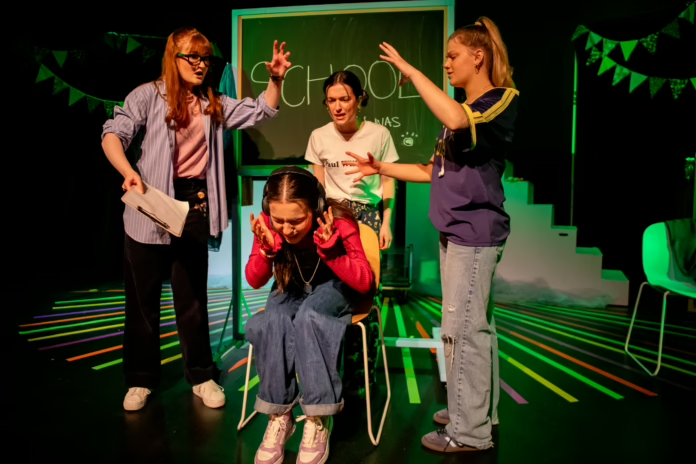
In the last few years Pulteney Grammar’s Year 12 productions have made considerable, often searing, challenges of their casts and audiences. The last two, Bound in 2023 and the 2024 TASA Youth Theatrical Award winning The Lovely Bones, were by any measure powerful theatrical experiences. Their experienced director, Jamie Hibbert doesn’t baulk at taking on serious and demanding theatre, requiring great skill of the individual cast members and the ensembles they so successfully develop. This production of Hibbert’s is no exception and builds on those recent successes. Unlike, say, repertory theatre companies who can rely on a certain number of cast members to carry over from one year to the next, a Year 12 production by definition each year presents a completely new cast to their audience.
We Live By The Sea has complexity on a number of fronts. The narrative is clear, yet not simple. Katy is a fifteen year old with complicated psychological problems, clearly some way along the autism spectrum. She lives near the seaside with her older sister Hannah, and is emotionally sustained by her imaginary friend Paul Williams, a dog. The many issues facing the sisters are explained and explored in some depth when seventeen year old Ryan arrives from London to live nearby with her mother. Despite the obvious potential barriers, Ryan befriends the girls, and the narrative unfolds.
Siena Pagnozzi was extraordinary as Katy. She brought a delicate, nuanced understanding to her character’s social awkwardness, and showed extraordinary emotional and dramatic range. Her most intense and disturbed moments come to us as both utterly authentic and deeply troubling. The audience was absolutely engaged, even entranced. This reviewer has dealt with teenagers living with such profound conditions and I have to say I found Siena’s interpretation to be entirely believable. Her minor obsessions, at times in muttered (yet intelligible) asides to herself and Paul Williams, were cleverly handled, and her consistency in the whole characterisation and often fraught relationship with the other three characters was a real strength. Her naive explanations of the way she was teased at school were uncomfortably compelling.
Zara Pagnozzi was her imagined confidante Paul Williams. She was highly skilled in this unusual and demanding role. Her alert observations and snappy physicality were forever supportive of Katy and allowed her at all times to give emotional support, yet – thanks to careful blocking and stagecraft – she never got in anyone else’s way. She was more than a mirror of Katy’s thoughts. She was akin to a skilled accompanist to a singer. Such was the empathy and understanding she showed. The occasional chorus-like shared lines with Katy were very well handled by them both.
Katy’s sister Hannah was played by Charlie Carr. She was well cast. She showed all the devotion and responsibility of a caring older sibling, and was also convincing in the utter frustration her pseudo-parental role often caused her. We felt sympathy for all three of the ‘real’ characters, but Charlie’s Hannah drew a particular empathy from the audience. There was an inevitability about her predicament, all the more pronounced because of the way Charlie showed Hannah’s understanding of it, and her inability to extract herself and Katy from their situation.
Sophie Haarmsma played Ryan, the newcomer to the seaside town. She did well to show how her character was both an observer of the sisters’ life and troubles, and a participant in the action of their family life. Through her, we came to appreciate how the outside world would – and did – deal with Katy and her needs. All this, while gradually revealing her own past and the troubles it held. Her Ryan was thoughtful and empathetic and displayed an inner firmness and trustfulness. In ways she was the saviour figure, while developing and learning from her new experiences with the sisters and the invisible friend. That is not an easy task, and she did it with calm conviction.
While each performer had moments of individual performance – indeed each had at least one major monologue – the ensemble work of all four actors was a strength. The action was therefore fluid and well paced. The close understanding of Zara and Siena Pagnozzi as Paul Williams and Katy was both physically and emotionally powerful.
The entire play, while being based on such serious, often harrowing moments, is not unrelentingly morbid. There were a number of lighter moments, usually conveyed by Katy’s totally honest and forthright pronouncements, and her excitement of having, for the first time a friend outside the family.
This was a well wrought production. The set was simple and aided the action. Downstage there was a boardwalk and sand to one side and a television set at the other corner. Both were well used. Upstage there were two sets of stairs and a central triangular stylised flag. On the flag we often saw illustrative video of the foreshore, the cast or a moving roadway. That was a novel and successful way to focus attention. The props were mostly stored in a locker-like cabinet, and were deftly and unobtrusively brought in and out of the action by one or other of the performers.
These strands drew together to provide a first rate piece of drama.
