

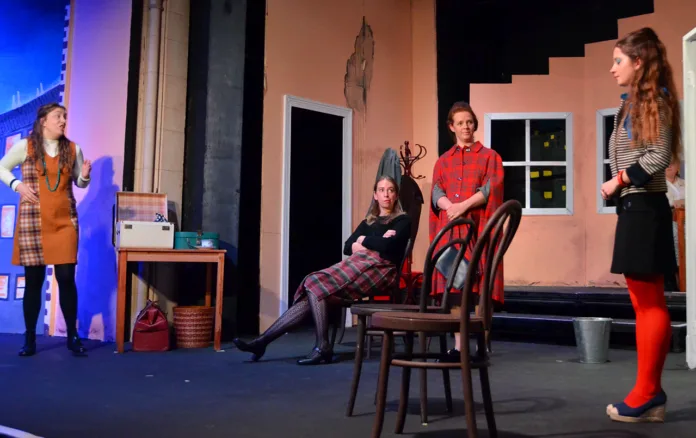
This play had dual casts, the Sassy Mauve case and the Stormy Rose cast. David Smith reviewed the Sassy Mauve cast and Alan Shepley reviewed the Stormy Rose cast.
Sassy Mauve Cast
Occasional lighter dialogue aside, this play is about profound loss and the different ways in which that loss affects its victims. Director Olivia Jane Parker has made the bold, well-reasoned choice to present the play with two entirely separate casts of five. I saw the Sassy Mauve cast, and was impressed with their character definition and the way they worked together as an ensemble.
The narrative involves four local women who have lost children in the 1966 Aberfan landslide which was caused by heavy rains dislodging in one of the hillside tips of the local colliery. Sian, in an apparently conciliatory gesture, invites a Revlon make-up representative to make a product presentation to the locals, to lift their spirits. Through much of the play, the Revlon Girl is the focus of the local women’s grief-filled speeches and revelations. Her responses often become the catalyst for their further action, both as individuals and as a group.
All four Aberfan women have distinct characters. While suffering the same degree of sadness, they have some obvious contrasts. As an ensemble, the cast did well to illustrate the interaction between the characters, experiences and beliefs of the village.
Georgette Mercer brought compassion and empathy to her role of Sian. She arranged the Revlon demonstration ostensibly as a means for others to feel better about themselves, yet her own needs also required fulfilment. Carmine Clarke was resolute and constant as Marilyn, whose beliefs in omens was hugely boosted by the disaster. Clarke brought us a credibly self-doubting and reliant soul, and played her fears well in her dealings with the others.
Olivia Richardson played Rona as brash, foul mouthed and direct. She was abundantly confident on the surface, and used obvious physical and facial gestures to generally good effect. Of all the characters’ revelatory monologues – and they all had one – Richardson’s was the most emphatic and carried considerable impact, thanks to both the content and her honest delivery.
Jade Cooper was humble and decent as Jean, the vicar’s wife. She played the role with strength and conviction, sufficient to contain the reason for her reticence in discussing her pregnancy, and when necessary, to stand up to Rona.
As the Revlon Girl herself, Ruby Patrich was well suited to the role. She had a confident, professional air and used her educated, well-modulated voice to very good effect. On a number of occasions she found herself listening as one or other of the characters directed their concerns, anger or doubts in her direction. While they may have used that as catharsis, Patrich showed a calm and interested understanding, and for the most part a certain naivety. On the occasions when, as the outsider, she made unwittingly inappropriate responses to another character, she skilfully conveyed embarrassment and discomfort. Her own, critically important monologue, was moving and powerful.
The action took place within a simple, functional set, featuring a cut-away profile, a free standing window and door, and a suggestion of the village seen through upstage windows, while at the left was a downstage counter. It served the purpose and action well enough. At times the action was well supported too, by glorious recordings of the Ynysowen male voice choir, providing a haunting background to the deep grief everyone was experiencing.
In all, this was an important and moving performance.
Stormy Rose Cast
I saw the “Stormy Rose” cast. However Heather Crawford (Rona) was unavailable for this performance and her place was taken by Olivia Richardson from the “Sassy Mauve” cast.
As Sian, Brooke DuBois presents a politely measured and likeable character. Before the disaster she loved nothing better than to get “dolled up” on a Friday night and go dancing with her husband. But since that ghastly day of frantically digging for their boy he has retreated into an impervious shell of dreadful, silent grief. DuBois presents Sian as a calming influencer, a fixer of things, a “salt of the earth” kind of person. But some things cannot be easily fixed and Sian’s disguised anguish hovers just below the surface. She is desperate for affection, a husband’s touch and, hopefully, another child. It is a fine, well controlled and well delivered performance by DuBois.
Marilyn (Megan Harris) has lost two daughters in the disaster. She has withdrawn into a world of forlorn hope and clouded unreality. She carries in her purse a drawing made the night before the event which she insists portends that terrible day. Harris’ performance with regard both to her stage manner and her facial expression is believable and commendable. That she tenaciously refuses to part with her last cigarette appears to be a telling analogy for her inability to come to terms with her profound loss and grief.
Olivia Bigham (as Jean) is indeed the epitome of a local vicar’s wife. As one would expect she is committed to her Christian belief system in order to assuage her loss and her grief. She encapsulates common sense and a continuing involvement in community. She is a busy person without being a busybody. She is also heavily pregnant which interestingly, perhaps understandably, makes her feel both embarrassment and shame. Yet, It is an obvious symbol that life inevitably moves on. Bigham inhabits the stage with an air of careful confidence and purpose thereby defining her character Jean’s perceived role in the future of Aberfan. This is also a fine performance.
Lucy Grace as the Revlon girl certainly looks the part. She gives her character a level of understanding and humility necessary in the circumstances of her Aberfan visit and planned cosmetics demonstration. In her monologue she gently reveals her own underlying sadness for a circumstance not too dissimilar from that of the ladies gathered before her. Grace provides her Revlon Rep with just the right measure of spiel mixed with genuinely felt empathy for her would be clients. And, in return, we feel an empathy for her.
With Olivia Richardson’s Rona what you see (and hear!) is exactly what you get. She is angry, bitter and cynical. It is a powerful combination indeed but it doesn’t quite completely detract from her underlying understanding of her own humanity. Rona rails against the system, the levels of compensation given to all residents and the direction in which donation monies might be taking. Richardson has the advantages of a fine script but she expertly wears Rona very much on her sleeve for all to witness. All characters in this play carry a Welshness of accent quite admirably but Richardson is a stand out with both her clear enunciation and her professional projection. We hear everything she says. Among all other strong performances I loved hers. All in all it was a moving evening with the St Jude’s Players!
Photo credit: Les Zetlein
