

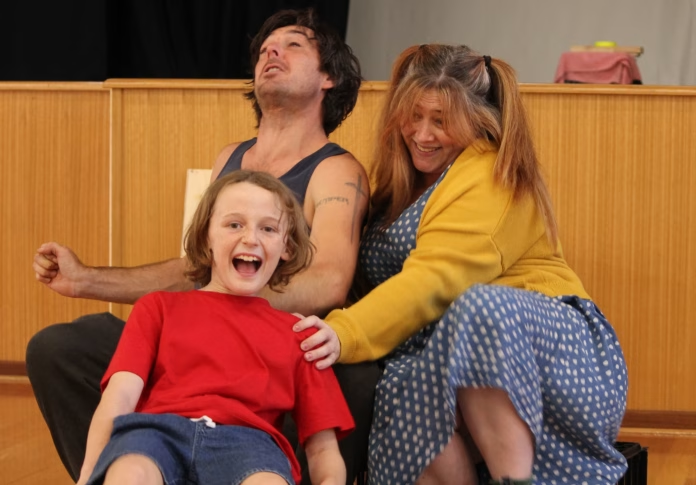
Love, by Finegan Kruckemeyer, who has called Adelaide home from a young age, follows Oslo, a boy living with his lively mum Ruthy in the fictional town of Mellingong, as a huge storm forces the community to evacuate to the town hall on the hill. With space limited to only a few precious belongings, the idea of “love luggage” becomes central: each person must choose the items that hold the most emotional meaning.
The story tracks Oslo as he helps gather and safeguard these chosen treasures, transforming a practical evacuation into a heartfelt reflection on memory, family, and what people value most. At its core, it is a community story about love under pressure, with the storm acting as the catalyst that reveals what matters most to each character.
Just as the story centres on community, so too does Blackwood Players’ production, supported by an extensive network of local contributors. Fleurieu Milk Company donated flavoured milk for sale and the milk crates used on stage; the Men’s Shed of Burnside built the steps; printing was completed by Catherine Hutchesson MP’s office… the list goes on. One can only imagine the coordination required to bring these contributions together so successfully.
First-time director Brooke DuBois has assembled a cast of 23 community members who clearly share a love of the arts, ranging from seasoned performers to three children just six years old. Each cast member performs with enthusiasm and commitment, creating a genuine sense of family on stage, strongly anchored by the actors playing Ruthy and Oslo.
Emma O’Connell takes on the central role of Oslo and delivers a captivating performance, maintaining audience engagement throughout the hour. O’Connell has a natural presence that draws the audience in, leaving them eager to hear each next line.
As Oslo’s mother Ruthy, Carly Whitaker provides strong support to Oslo’s journey while also shaping her own character with care. However, with the production relying on natural projection rather than microphones—particularly in the vast Blackwood Memorial Hall—there were moments where Whitaker (and others) were difficult to hear.
Narrators Beren Carney and Dr Christina Hagger work well as a pair, guiding the audience through past stories as characters reveal the meaning behind their love luggage. They are lively, energetic, and engaging, though occasional pacing issues disrupt the flow that would otherwise maintain smoother momentum.
Rebecca Gardner, Matthew Chant, Katie Adams, and Eryn Kralj appear in supporting roles as Krishna, Tony, Trish, and Danica respectively, each bringing a distinct presence to the stage while helping to carry Kruckemeyer’s story through its flashback sequences with clarity and purpose.
Gardner delivers a grounded and sincere performance, giving emotional weight to her moments, while Chant brings a natural ease that makes his character feel authentic and fair dinkum relatable. Adams adds warmth and nuance, capturing the heart of her role with subtlety, and Kralj rounds out the group with confident, expressive choices that enhance the storytelling. Together, they form a cohesive ensemble within these scenes, ensuring each memory is clearly defined and engaging without ever pulling focus from the central narrative.
The staging makes thoughtful use of the venue, with limited seating and opportunities for children to sit on the floor at the front, creating an intimate and welcoming atmosphere within the large hall. Much of the action takes place on the floor, while smaller moments are mimed on stage, resulting in an overall feel reminiscent of a children’s story time.
Singer-songwriter Jen Lush and the Eden Hills Kindergarten provide the recorded music and songs as audiences enter, and the production begins with a sung Acknowledgement to Country recorded by the kindergarten—a refreshing alternative to the spoken form.
Choreographer Cheylene O’Brien has crafted movement and dance sequences that beautifully capture both the essence of the story and the director’s vision. Each memory scene features distinct choreography that enhances the storytelling without ever feeling overcomplicated.
Composer Gareth Chin’s underscore effectively supports and enriches the narrative, while artist Roger Weiss—present in the audience—created the projected artwork used as backdrops throughout the play.
Each production element contributes meaningfully to the overall experience, enhancing the storytelling without drawing focus away from the cast. Blackwood Players’ Love is a heartfelt production that celebrates community both on and off the stage. Guided by a clear vision and performed with warmth and sincerity, it captures the emotional core of Kruckemeyer’s writing, offering a moving and reflective experience despite a few minor areas for refinement.
