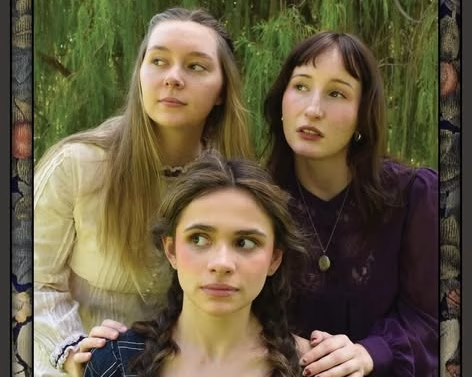
Spring Awakening is a confronting exploration of adolescence, repression, and the consequences of silence. Theatre Guild Student Society’s production seeks to establish the relatability of its characters to our own adolescent experiences, and to a large extent, it achieves this. Themes of academic pressure, fear of failure, and the danger of ignorance come through clearly. Though often sombre in tone, moments of lightness do emerge, allowing the audience to laugh knowingly at the naivety and experiences of the central characters.
Performance-wise, there is much to commend. Chloe Browne shows Melchior’s intelligence and confidence, while also revealing him as a flawed young man still learning and making mistakes. Eva Wilde’s Wendla brings a believable innocence, and she shares a natural connection with Chloe Browne that makes their scenes work well.
April Strevens’ Moritz captures both the fragility and internal conflict of the character, effectively communicating his insecurity, curiosity, and growing fear. The pressure to succeed — and the consequences of perceived failure — are clearly realised.
Among the supporting roles, Lucy Thompson’s Frau Bergmann feels entirely believable as Wendla’s mother, with Georjette Mercer’s Frau Gabor offering a similarly convincing portrayal. Bel Watson’s Ilse conveys a sense of lived experience that contrasts effectively with Wendla’s innocence, while Max Lock handles a challenging scene as Hanschen with confidence and control.
The ensemble works well to create a cohesive world, supporting the principal action and contributing to the overall atmosphere.
The non-traditional casting of the two central male roles is handled effectively and does not detract from the storytelling, allowing the focus to remain on character and theme.
Jessie Chugg (Director) and her team approach the material with clear care and courage, particularly in its handling of sensitive and confronting themes. Several key moments are staged with thoughtfulness and restraint. The depiction of Wendla’s assault, presented in shadow behind a white drop, allows the moment to be conveyed with impact without needing to be explicit. Similarly, the earlier scene between Wendla and Melchior is carefully choreographed, beginning separately and escalating into physical interaction. The staging of Moritz’s death is also effective, with the decision to cover and remove the body preserving the integrity of the moment.
At times, the storytelling feels somewhat disjointed, with transitions between scenes occasionally lacking flow. Despite a minimalist set, some scene changes linger longer than expected, interrupting the momentum. Additionally, some dialogue is hard to follow due to the pace, which at times makes it difficult to stay fully connected to what is happening.
Visually, the production makes effective use of a simple design. Hay bales and chairs are employed with creativity to establish a variety of locations. The lighting design by Isaac Cassey works well, creating atmosphere and supporting the tone of the piece.
Overall, this is a production that takes on some very difficult material and handles it with care, with a number of strong performances and thoughtful moments. While issues with pacing and flow mean it doesn’t always come together as smoothly as it might, it remains a sincere and often affecting production.