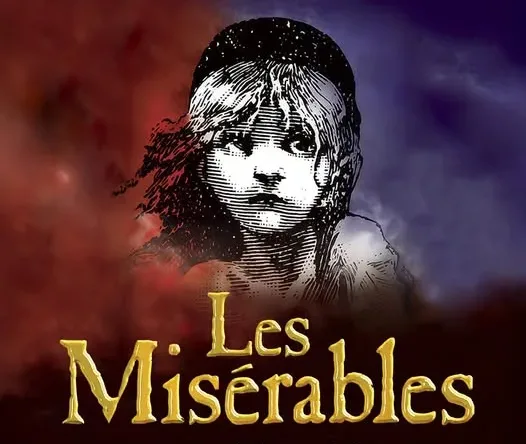
This production had dual casts in several of the principal roles. In the interest of fairness to all, we reviewed both casts. Kym Clayton reviewed the Noir Cast and Tegan Gully-Crispe reviewed the Rouge Cast.
Noir Cast
Adelaide Youth Theatre is one of Adelaide’s most prolific producers of musicals, and they have an enviable supply of volunteers, supporters, and participants. They can be relied upon to produce competent shows that never fail to entertain, and, importantly, they provide a solid training ground for tomorrow’s performers and creatives which they have been doing since 2010.
AYT’s current production is the musical Les Misérables. It was composed by Claude-Michel Schönberg with a French libretto by Alain Boublil; the English-language lyrics that made the show globally famous were adapted by Herbert Kretzmer from Boublil’s original French text. The English staging was directed/adapted by Trevor Nunn and John Caird with additional material by James Fenton. The English version made famous by the iconic Cameron Mackintosh is therefore celebrating its fortieth anniversary around the world, and the 2025 Royal Variety Performance featured songs from ‘Les Mis’ and included singers from non-professional theatre companies throughout the UK that had performed the show. The quality of the singing was breathtaking, and embodied crystal-clear diction and superbly controlled dynamics.
Set in post-revolutionary France, Les Misérables follows ex-convict Jean Valjean’s quest for redemption after breaking parole. Hunted relentlessly by Inspector Javert, Valjean builds a new and respectable life under an assumed name while rescuing Cosette, Fantine’s orphaned daughter, from the guardianship of the dissolute tavern owners Monsieur and Madame Thénardier. Paris is mired is mired in poverty and injustice – the legacy of years of political turmoil and war – and a group of idealistic students headed by Enjolras lead a doomed uprising with tragic outcomes for many. Marius, one of the students, survives because of Valjean’s intervention and is reunited with Cosette. Marius is also admired by Éponine, but she perishes in the uprising as well. Throughout the show, lives intersect through love, sacrifice, and moral choice. It all culminates in Javert’s tragic collapse, Valjean’s spiritual peace, and Marius and Cosette’s nascent love.
Les Misérables is one of the most enduring and celebrated musicals in theatre history and has earned numerous accolades around the world including Tony Awards, Laurence Olivier Awards, Helpmann Awards, and Oscars for a film adaptation.
So, AYT have bitten off quite a lot to chew: Les Misérables is not for the faint hearted. It presents enormous challenges: diverse period settings and costumes, sophisticated music, emotionally charged songs that are technically demanding to sing. Because the show is so well known, audiences have certain expectations about the production values, and they know the songs. A production company has nowhere to hide. Happily, AYT rise to the occasion and present a creditable production, but it has a few issues that need to be ironed out!
A feature of AYT productions is heavy use of technology, especially giant digital projection scenes to provide scenic backdrops (which were excellent in this production), and voice amplification for some principal cast members. In both cases, the production’s impact was dented by failures in these two areas: the projections flickered throughout act one, and totally malfunctioned in act two (apart from some brief and minor projections at the sides); almost all principals were over amplified, and the sound production was over-processed with substantial loss of voice clarity. If you didn’t already know the nature of the settings in act two, you might be at a disadvantage, and if you were not at least broadly familiar with the text of the songs, you might not fully understand the unfolding of the plot and the turmoil of each of the characters. The orchestra, which was very good, played behind scenes, but would have been better placed in the auditorium so that the cast could be guided by the musical director.
Despite these misgivings, the principal cast was, in the main, excellent.
Mat Monti brought to the fore Jean Valjean’s moral awakening, compassion, and self-sacrifice. His performance of “Bring Him Home” was superb. He is a young performer to watch out for.
Andrew Crispe is of course well known throughout Adelaide. His voice is a glorious instrument and has graced many stages, both professional and community alike for a number of years. As Javert he added maturity and certainty of voice to the production, and he helped enhance younger performers around him with his superb diction, nuanced vibrato, timing, and sense of rhythm and meter. Crispe’s rendition of “Stars” was spine chilling, and Javert’s unshakeable belief in the law, and his moral absolutism was clearly evident.
Ethan Joy played Marius with youthful enthusiasm and has a delightful emerging tenor voice. Marius’ idealism and survivor’s guilt came though clearly with Joy’s impassioned performance of “Empty Chairs at Empty Tables”.
Grace Sexton played Fantine and laid bare her vulnerability and dignity with a touching performance of “I Dreamed a Dream”.
Indie Tunnah, as young Cosette, sang “Castle on a Cloud” with sweet innocence, and Jasmine Howis, as older Cosette continued that with her gentle performance of “In My Life”.
Josh Curtis played a convincing Enjolras and embodied revolutionary zeal and leadership when he sang “Red and Black” and “Do You Hear the People Sing?”
The Thénardiers worked hard to achieve the demands of the roles but appeared to be directed to aim for slapstick rather than comedic menace. The audience however loved their antics and the relish with which they sang their bawdy songs.
A standout was Zoe Waters in the role of Éponine. Her “On My Own” was a highlight of the show, and, thankfully, the sound engineering didn’t interfere with her lovely soprano voice. She pitches well, has good breath control, and the gentlest vibrato.
The ensemble singing was excellent throughout, and the finale was especially moving. It was a fine example of balance, well controlled dynamics, clear phrasing, empathetic choreography (which was tight and well-constructed throughout the show), and sound engineering that didn’t interfere with the human voice.
On a number of occasions, some soloists tended to reserve their voices and breathing to allow them to sustain long notes at the end of musical phrases and ‘belt out’ the song. Sadly, this is now common in popular singing and, as impressive as it may sound – the audience frequently cheered – it can detract from the performance (in this reviewer’s mind at least.) Pleasingly, Andrew Crisp, Mat Monti and Zoe Waters maintained emotional intensity without vocal strain.
Matt Smith’s direction had the show flowing smoothly in the main, although some of the narrative arc was vague: Valjean’s escape from custody needed to be more obvious; Javert’s suicide scene merits greater visual impact; Valjean’s display of strength in rescuing a worker trapped under a cart needed to be more convincing. Smith used the expansive stage of the Futures Theatre well, and he had his cast move easily around it. The lighting was evocative throughout, and some scenes might have been lit more intimately to enhance mood and to distract attention away from the slick stage crew.
As previously remarked, Les Misérables is not for the faint hearted, and AYT have produced an enjoyable production with a number of spine chillingly good moments.
Rouge Cast
Jack Keukenmeester delivered a sincere and deeply engaging performance as Marius, bringing emotional depth and authenticity to the role. His smooth, expressive singing voice was a pleasure to listen to, and he confidently held his own alongside more experienced cast members such as Crispe and Monti. His on-stage chemistry with Cosette, played by Iris Nissen, was particularly strong, creating a believable and touching partnership. Nissen brought a sweet, genuine quality to both her singing and acting, and together they made a visually and emotionally compelling pair on stage.
Young Cosette, portrayed by Bethany Swift, was a strong and well-matched younger counterpart to Nissen’s Cosette. She performed with clear innocence and sincerity, supported by a sweet, gentle singing voice that effectively captured the character’s vulnerability.
Alyssa Faranda’s portrayal of Eponine was a standout performance of the production. She demonstrated exceptional depth in her acting, paired with impressive vocal control and variation. Her performances in “On My Own” and “A Little Fall of Rain” were particularly powerful, with the latter being especially believable and emotionally gut-wrenching, leaving a strong impact on the audience.
Riley Mobbs portrayed Enjolras with the right balance of passion and control, establishing himself as a natural and convincing leader.
Asher Gordon and Rebecca Etienne were delightfully repulsive as Thenardier and Madame Thenardier, embracing their characters and delivering numerous moments of comic relief.
Mia Khairul brought Gavroche to life with confidence and plenty of gumption. Her spirited performance added vitality to the show and captured the bold, cheeky nature of the character with charm and enthusiasm.