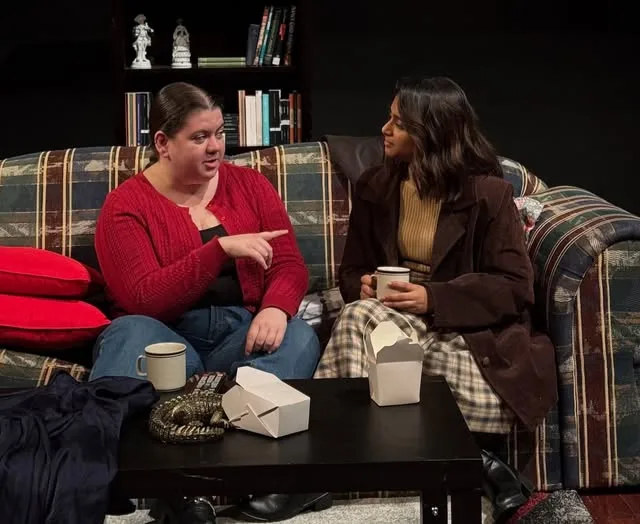
Stop Kiss unfolds through a non-linear structure, weaving moments from before and after a single, life-altering incident. At its centre are Callie, a cautious New York radio traffic reporter, and Sara, a newcomer to the city finding her independence. Their friendship deepens into an unexpected romantic connection, abruptly interrupted by an act of violence. Rather than dramatise the event itself, the play focuses on its emotional aftershocks, exploring how love, identity, and memory are reshaped when intimacy collides with fear and public systems.
TGSS made a bold and commendable choice in staging this quietly devastating work. Stop Kiss demands restraint, trust, and precision, and the company approached the material with enthusiasm, sincerity and clear respect for the text.
The production was anchored by two strong central performances. Esther Burnett delivered a grounded and thoughtful portrayal of Callie, capturing her caution, dry humour, and emotional conflict with clarity. Callie was played with a gentle stillness that gave the character real depth. The performance captured her hesitation and sensitivity in a way that felt natural and relatable, drawing the audience into her inner world without ever overstating it. As the play unfolded, Callie’s journey felt honest and grounded, helping anchor the emotional heart of the production.
Opposite her, Elizabeth Lijo brought warmth and openness to Sara, allowing curiosity and vulnerability to emerge naturally. Sara was played with an easy openness that made her immediately engaging and believable, allowing the character’s curiosity and vulnerability to unfold naturally. Small moments, such as a pause, a smile, a shared look that carried real weight, and the emotional shift following the incident was felt without being overstated.
Together, their chemistry was understated and convincing, enabling the relationship to develop gradually and honestly. The kiss itself was handled with restraint, initially accidental, small, and yet quietly seismic. Exactly as the play required.
The supporting cast, though appearing in brief but essential scenes, effectively shaped the world surrounding the central relationship. Jalen Berry was particularly effective, subtly occupying moments that disrupted and complicated the growing attraction between Callie and Sara. Ashram Abdul Halim brought clarity and composure to the forthright Detective, grounding the investigative scenes with calm authority. Liam Warmeant contributed a measured, focussed and determined portrayal of Peter, while Zoe Russell-von Bujdoss supported the narrative with sensitivity, finding contrast between the two character’s she portrayed. Collectively, these roles functioned well as representations of the external systems (social, medical, and institutional) that frame and at times obstruct the couple’s journey.
Where the production struggled most was in pacing and transitions. Scene changes were consistently lengthy, and rather than supporting the play’s non-linear movement, they repeatedly slowed momentum. These extended transitions significantly lengthened the running time and created a pronounced stop-start experience for the audience.
Stop Kiss relies on emotional accumulation and flow, the sense that memory folds seamlessly between past and present. In this production, each prolonged transition disrupted that continuity, asking the audience to repeatedly re-enter the world of the play. As a result, moments that were emotionally strong and well performed sometimes lost impact through interruption rather than lack of clarity.
The set design and use of the upper performance area, while visually considered, further contributed to this slowing of the story. The added spatial complexity increased transition time and worked against the play’s need for simplicity, intimacy, and immediacy. A more pared-back approach to staging may have allowed the audience to travel more fluidly through this beautiful, poignant, and important narrative.
The music and soundscape were undeniably beautiful and musically accomplished, reflecting careful composition and intention. At times, however, the sound underscoring became a distraction rather than a support. In a play where silence functions as action, the score occasionally formed a barrier between the audience and moments that were already emotionally rich and well told. Greater trust in silence may have strengthened intimacy and sharpened the emotional impact.
The final moments of the production were quiet, unresolved, and honest. This was a fitting conclusion to a play that resists neat resolution. The lingering silence leaving the audience holding emotion rather than explanation.
Behind the performances, several strong supporting contributions enabled the cast to truly glow. The creative team worked with evident care and consistency, creating an environment in which thoughtful, restrained acting could emerge. Director Josh Manoa clearly marshalled the team with purpose, guiding the ensemble toward a shared understanding of tone, intention, and emotional truth. The result was a genuinely collaborative production — one that reflected trust between performers and creatives, and a collective commitment to honouring the play’s delicacy and importance.
Overall, this was a thoughtful, compassionate, and ambitious production. TGSS should be commended for taking on such delicate material and for delivering a version of Stop Kiss that demonstrated emotional intelligence, strong performances, and deep respect for the text. With greater simplicity in staging and a clearer commitment to swift, uninterrupted transitions, the production’s many strengths would have been given even greater room to resonate for the audience.