Peter Goers in association with Holden Street Theatres
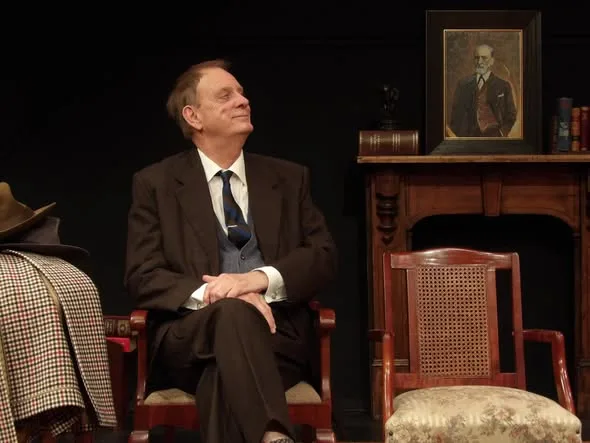
As his tenure as Resident Director of Holden Street Theatres Inc. draws to a close, Peter Goërs swaps the director’s chair for the on-stage limelight and stars in Mary Chase’s 1944 Pulitzer Prize winning play “Harvey”. Goërs has cast himself in the lead role (having first performed it more than twenty years ago), recruited most of the cast, and invited community theatre stalwart Rosie Aust to direct the production.
The focus of the play is squarely on Elwood P. Dowd (played by Goërs), an amiable, endlessly polite and gentle soul, whose best friend is a six-foot, three-and-one-half-inch invisible white rabbit named Harvey. This is a constant source of embarrassment to his sister Veta Louise Simmons and her daughter Myrtle Mae. Veta is ever upwardly mobile on the social ladder, and is appalled that Elwood’s propensity to introduce Harvey to all and sundry hamper Myrtle Mae’s attempts to secure a suitable husband. One of Veta Louise’s afternoon tea guests, Mrs Chauvenet, is one who becomes rattled when introduced to Harvey and is rendered almost catatonic by the experience (or maybe it was by the deliciously bad performance of Mozart’s Queen of the Night aria whining away in the background?!) Veta Louise (for whom the Queen of the Night may well be a metaphor!) decides that enough is enough and with the conniving assistance of Judge Gaffney she plots to have Elwood ‘dealt with’ by the medical fraternity.
The play addresses a number of themes that still resonate today, such as mental health, the nature of sanity, social orthodoxy, and the value of kindness. In today’s culture there is an imperative to accept diversity in spite of the challenges this may present, and Elwood is Mary Chase’s 1944 exhortation to do the same.
A key feature of the action is Elwood’s gentleness and charm. As he says at one point, if it’s a choice of being smart or pleasant throughout life’s journey, then he recommends pleasant! Indeed, Chase’s script puts many quotable quotes into Elwood’s mouth, and in some scenes they come thick and fast and are variously greeted with chuckles (sometimes guffaws) by the audience, especially in the delightful first scene in Act 2. But you have to listen carefully, because Goërs chooses to play Elwood at a very gentle volume, and to stylishly underplay him (sometimes in an almost detached manner). Aust and Goërs never allow Elwood to be reduced to caricature, but Elwood’s unflappability (particularly in Act 1) is sometimes portrayed as being ponderous and languid. In the main, Goërs mimes Harvey’s existence well enough (showing him into the room, offering him a seat, introducing him to guests etc) but, amusingly, Harvey’s height seems to change at times!
Rebecca Kemp plays Veta Louise with style and humour and pushes her almost to farce but stops just short. Stamos gives Myrtle Mae a keen sense of desperation at being ‘left on the shelf’ and successfully plays the role with impetuosity and some delightful slapstick. Ron Hoenig plays Dr Chumley MD and parodies what it is to be a psychiatrist. He seemingly evokes Dr Prentice from Joe Orton’s What the Butler Saw! Alongside of Chumley is his colleague Dr Sanderson played by Christopher Cordeaux, who imbues the role with wet-behind-the-ears nervous innocence. Antoinette Cirocco does very well as Nurse Kelly, and injects much needed pace. Leighton Vogt plays hospital orderly Duane Wilson and is ‘bad cop’ to Cirocco’s ‘good cop’. They complement each other very well. Brian Wellington is sufficiently stuffy as the judge, Amanda James is genial as the homely wife of Dr Chumley, Megan Dansie is suitably eccentric as Mrs Chauvenet, and Robert Cusenza’s nicely performed cameo role at the very end of the play proves the old saying there is no such thing as small roles, just small actors!
Designed by Aust and Goërs, the set is simplicity itself. The two main settings – Veta Louise’s parlour, and a medical consulting room – use the same furniture and all that changes is a painting over the mantlepiece to suggest the two locales. Simple, but every effective, and one of the prop paintings by Brian Budgen is a masterpiece! Costuming shows attention to detail and faithfulness to the period. Lighting is a simple wash – all that is needed – but there’s an annoying light that strongly illuminates a handful of the audience.
“Harvey” is now eighty years old and is perhaps creaking under the weight of its years, but it is still dusted off and re-mounted from time to time. It undoubtedly has an enduring charm and still speaks gently to us to be kind when dealing with others, but perhaps it is too gentle for today’s world, and especially for younger members of the audience.
This quaint play teeters between comedy and farce, which runs the risk of diluting its impact. Aust wisely edges towards light comedy and allows the skill of the cast to expose Chase’s message: be kind, be tolerant, be accepting.
Kym Clayton