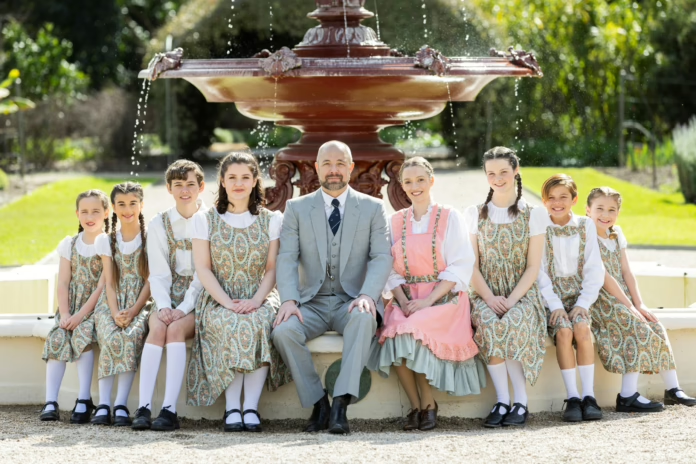
This production features alternating dual casts for six of the seven Von Trapp children. The role of the eldest child – Liesl von Trapp – is played by Teresa Van der Hoek for all performances. In an affectionate nod to the composers of this much-loved musical, the two casts are referred to as the “Rodgers cast” and the “Hammerstein cast”. In the interest of fairness, we reviewed both casts. David Smith reviewed the Rodgers cast and Kym Clayton reviewed the Hammerstein cast.
Rodgers Cast
It’s tempting to recall the disparaging line from the then revolutionary 1968 musical Hair, “The hills are alive with the sound of ….(expletive deleted)”. Such musicals were set to sweep away the more traditional ones such as The Sound Of Music. Well, they didn’t, and it’s just as well. The G&S Society’s revival is worthy in a number of ways, and reminds us of the power of well written songs, and the significance of the 1938 German Anschluss into Austria. It’s also well timed, considering the precarious state of our world today.
Director Adam Goodburn brought us a traditional interpretation, within a straightforward but functional set. The interpretation held together well and presented the characters and the plot with clarity. It’s a musical, so of course the songs are critical. MD and conductor Liam Phillips did wonderfully with both soloists and the ensemble, and the orchestra was a real highlight – well tuned and modulated – supporting the cast with sensitivity at all times.
The cast was uniformly impressive. Performing such a well known and well loved musical can be tricky, given the audience’s familiarity with other versions, prime among them in this case the Julie Andrews and Christopher Plummer film. This G&S cast carried the roles with ease and conviction and were enthusiastically received and rewarded by the big first night audience, as they deserved to be.
From the outset Emily Fitzpatrick charmed us as Maria. In her character she combined naivety with an inner sense of determination and purpose. She sang all the beloved songs with clarity, precision and charm. She gave every reason for the children to love her and worked well with Andrew Crispe as Georg. Crispe warmed the audience with his clear baritone in both dialogue and songs. He brought a gravity and staunch credibility to the role. He was uncompromising in his loyalty to Austria, yet showed a social softening under Maria’s influence.
Megan Doherty was a convincing Elsa Schraeder, giving us a nice worldly contrast with Maria, while Nicholas Bishop was confident, friendly yet duplicitous, and very amusing in the role of Max Detweiler, the political chameleon who tired so hard to convince Georg to ‘be wise, compromise’ with the invaders. Both Doherty and Bishop played that middle political ground with conviction – neither jingoistic Austrians nor total collaborators.
Susie O’Connell was remarkable as the Mother Abbess. She was formal and distant as the head of the convent, yet showed the necessary compassion to Maria. Her “Climb Ev’ry Mountain” was one to be reckoned with. Further, she led the nuns with authority. While on the subject of the nuns, it must be said that their several choruses were a delight. They were finely tuned, brought out the rich harmonies and, when necessary, sang with amazing strength.
The young love interest, the ‘sixteen, going on seventeen’ couple Liesl and Rolf, played by Teresa Van Der Hoek and Matthew Boyd, were delightful in their duet and early, coyly flirtatious, encounters. Van Der Hoek, as the oldest Von Trapp child, led the family group confidently and graciously, while Boyd’s character was reassuring at first but distanced himself when politicised later in the action.
The other six children delighted the audience at almost every utterance and action. They worked well both individually and as a group, singing their several songs brightly and joyfully. The littlest ones, Lucy Harry (Marta) and Kaia Hodges (Gretl) charmed with their natural sweetness and innocence, Estelle Kouzapa (Brigitta) made the most of her character’s naive honesty and outspokenness, Eden Lane (Louisa) established her strong nature and emerging sense of questioning independence while the boys Alixander Davis (Friedrich) and Loe Hede (Kurt) were noteworthy for their crisp movement, clear singing and exuberant character.
Apart from the main set, mostly the interior of the house or abbey, scene changes were effected by the use of a downstage scrim, flown in, on which large images – often of substantial stone buildings – were projected. The images were well chosen, yet they suffered somewhat from the very light cloth of the scrim, which waved disconcertingly, at the slightest movement on stage.
That aside, this was a heart-warming and affirming performance and one which the audience enthusiastically embraced.
Hammerstein Cast
This review concentrates on the performance of the six children of the Hammerstein cast.
The roles of the von Trapp children are crucial to the emotional arc of the story – they clarify the characters of Maria and Captain von Trapp. Essentially the children hasten dramatic changes in the affairs of the von Trapp family, and they underscore the almost antithetical worlds of discipline contrasted with freedom, and duty giving way to love. They also indirectly provide the vehicle for the wisdom and deep love that the Mother Abbess has for her religious community to shine through, as she encourages Maria to find her true path in life. In a more obvious way, the children through the agency of Maria allow von Trapp to escape the shackles of his deep sense of loss for his lost wife and unleash the deep but hidden love he has for his children. In blunt terms, the children dramatize the stakes of the story: they are the link that eventually bind Maria and von Trapp.
With such a vital role in the story, there is an obvious weight of responsibility on the shoulders of the young actors playing the von Trapp children, and director Adam Goodburn has chosen well with the Hammerstein cast. When lined up, from youngest to oldest, even their relative heights are near perfect!
Aidan Salmon plays Friedrich and early in the play mirrors his father’s rigid devotion to duty and restraint. Salmon allows Friedrich to gradually loosen up as he yearns for his father’s affection, as do all the children. Evie Dew gives Louisa just the right amount of playful mischievousness as well as budding maturity, and Sid Ion is totally disarming as Kurt with a broad smile as he plays tricks on Maria, which are in truth expressions of his affection for their new Governess as she inspires the children rather than controls them. Mia Khairul plays Brigitta with great enthusiasm, joy and disarming honesty. Khairul comically gives truth to the phrase “out of the mouths of babes” when she announces to Maria that she and von Trapp are surely in love with each other but can’t see it, or won’t admit it! Marlo Bellison as Marta and Audrey Fitzpatrick as Gretl play the two youngest children, and they are sweetness, innocence and cuteness personified as they immediately gravitate towards Maria as if she was the living mother they cannot remember.
As an ensemble, the Hammerstein cast sing very well indeed and are precise in the execution of their choreography without it feeling overly ‘studied’.