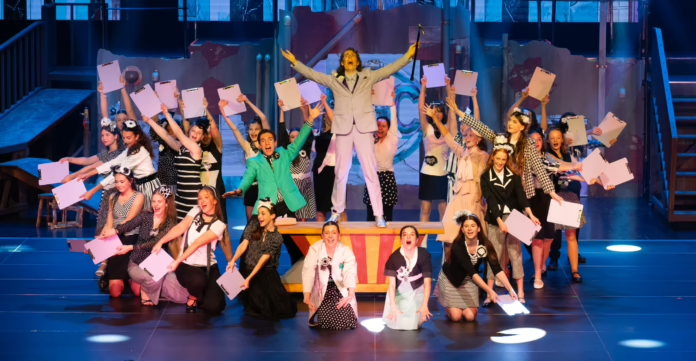
Wow! Wow! Wow! Pulteney Grammar School’s production of “Urinetown: The Musical” is just fabulous. There are not enough superlatives to say how good this production is. The only downside is that it is playing for a very short season, and closes on 31 May, so get in quick!
With every production, Pulteney’s musical theatre program goes from strength to strength, and they are frequently award winners. Yes they are ‘school productions’ but they are underpinned by production elements that reek of professionalism. Indeed, they bring in professional creatives (such as directors, choreographers, designers, builders, lighting and sound technicians etc) to provide inventiveness and brilliance, and especially motivation and tutelage to the student casts who respond with enthusiasm and positivity as they hone their craft.
Simply put, a Pulteney musical theatre production is an excellent training ground for the stars of tomorrow!
So, what’s it all about?
Urinetown: The Musical is a satirical, meta-theatrical comedy set in a dystopian future where a severe water shortage has led to the prohibition of private toilets. Citizens are forced to pay to use public restrooms controlled by the corrupt Urine Good Company, headed by the ruthless Caldwell B. Cladwell. The story focusses on Bobby Strong, a lowly restroom attendant who becomes the leader of a populist revolution after his father is arrested for relieving himself in public. Bobby falls in love with Hope Cladwell, the idealistic daughter of the company’s CEO, who eventually joins his cause. Bobby evolves from a passive worker to a radical leader, while Hope transforms from a sheltered heiress to a compassionate ally of the oppressed.
Key songs include “Run, Freedom, Run!” (Bobby’s anthem of rebellion), “Follow Your Heart” (a duet with Hope), and “Privilege to Pee” (sung by Penelope Pennywise, Bobby’s boss and keeper of the truth about Hope’s real parentage). They are sung very well, and voice amplification is very good (although early in the performance the balance was not optimal, but this was soon sorted.)
Urinetown: The Musical critiques capitalism, corporate greed, environmental degradation, and social inequality, all while parodying musical theatre conventions. The text draws attention to itself as a theatrical production and blurs the lines between the world of the play and the reality of the theatre. Through two of the principal characters – Officer Lockstock and his sidekick Little Sally – the play explicitly and comically comments on its own structure, the nature of theatre and acting, and blurs the relationship between the audience and the performance. The so-called ‘fourth wall’ is frequently mashed asunder, and it is oh-so-funny when it happens!
Urinetown: The Musical won three Tony Awards in 2002, including Best Original Score and Best Book of a Musical, and its appeal remains as fresh as when it was first written. The principal cast members of the Pulteney production are just terrific and they turn out performances that vindicate the substantial resources that the school has invested in the production. Patrick Longden as Bobby Strong is commanding. He dances well, sings with heart and soul and, importantly, is tuneful, and his characterisation is appropriately understated when necessary. He looks the hero. Alongside of him is Polly Schubert who plays Hope. Her singing voice is excellent, and like Longden, she moves superbly around the stage. Schubert is only in Year 10 at school, and already it is clear she is an accomplished performer and has a bright future on the stage. She is one to look out for.
Henry Green’s Officer Lockstock is dead-pan comedic gold. His narration to the audience is always a high moment, and it is done with such a straight face you just have to laugh. He has an excellent crystal-clear speaking voice and can be heard unmistakably throughout the theatre. Emily Puah’s performance as his side-kick Little Sally is also a joy. Her smile fills the stage, her sincerity is undoubted, and her dancing and singing perfectly complements Green. They combine superbly. Maggie Bridges plays Penelope Pennywise with an almost brooding rage. She too is only in Year 10 and has a bright future before her on the stage. Rounding out the principal cast is Billy Rowan as Caldwell B. Cladwell. She is exuberant in the role (especially in her lilac-coloured vibrant suit and glistening silver shoes!), and quickly establishes Cladwell as the villain.
And then there in excess of fifty-five others in the ensemble, and there is not a weak link amongst them, not one of them. Those playing the Rebels and other featured roles superbly complement the leading players: they dance, sing and act with style and conviction, and they are at all times convincing. In particular, Henry Tran as Hot Blades Harry, Keira Wubbolts as Senator Fipp, and Dash Heffernan-Lucic as Mr McQueen all turn out tremendous performances.
The stage at the Futures Theatre, Paradise, is large and unforgiving. No, it’s worse than that: it’s enormous and merciless. It needs a set that is large and larger than life, and intensity of lighting that almost drains a small town’s electricity supply. Director Jo Casson’s set design is simple but effective: a large upstage scaffold that houses LED screens and a mezzanine accessible by seen and unseen staircases, and free-standing structures stage left and right that evoke dystopia. Chris Hill, from Inset Creative, constructed the set and it is terrific. Lighting and sound by Mosaic Audio Visual, Mark Oakley and Campbell Lawrence is striking. Digital projections by Richard are also fabulous, and are fundamental to the success of the entire look and feel of the production. With so many in the cast, it could be forgiven if the costumes occasionally lacked attention to detail, but they didn’t. There are dozens in the costume team, and they have produced a cornucopia of wonders.
The small orchestra is seated off stage and only the conductor Jonathon Rice is visible to the cast via a monitor. They did not miss a beat all performance. Beautifully trained and responsive. The vocal director Katia Labozzetta and choral coach Annie Kwok have also done a wonderful job, and Rosanna Dobré and Jo Casson’s choreography is a highlight of the production. (Jo Casson’s hand is all over this production. She has done a sterling job!) Dance routines are sharp, articulated, empathetic with the music and dialogue, and frequently add comedic value. Crucially, the larger routines are well executed by the ensemble. Synchronisation is a highlight.
This review began with Wow! Wow! Wow!
I say it again. Wow! Wow! Wow! and apologies to the almost countless number of individuals listed in the program whom I haven’t mentioned. There are just so many of you, and you are all important and you have all excelled.
Photo credit: Stagelit Photography